Architecture is an endeavor that is inextricably linked to people’s daily lives.
“We aim to create a society where it is the norm for everyone, everywhere in Japan, to live in homes that are healthy, comfortable, and safe”—it is with this grand vision that Professor Mae of the Department of Architecture at the University of Tokyo is dedicated to research and education.
In this article, Professor Mae will share insights from his firsthand experience in education and research, highlighting the importance of improving residential insulation performance and providing examples of how the digital tool " Scanat " is being used.
Video Compilation
The "Five Pillars" Supporting Eco-Friendly and Comfortable Homes
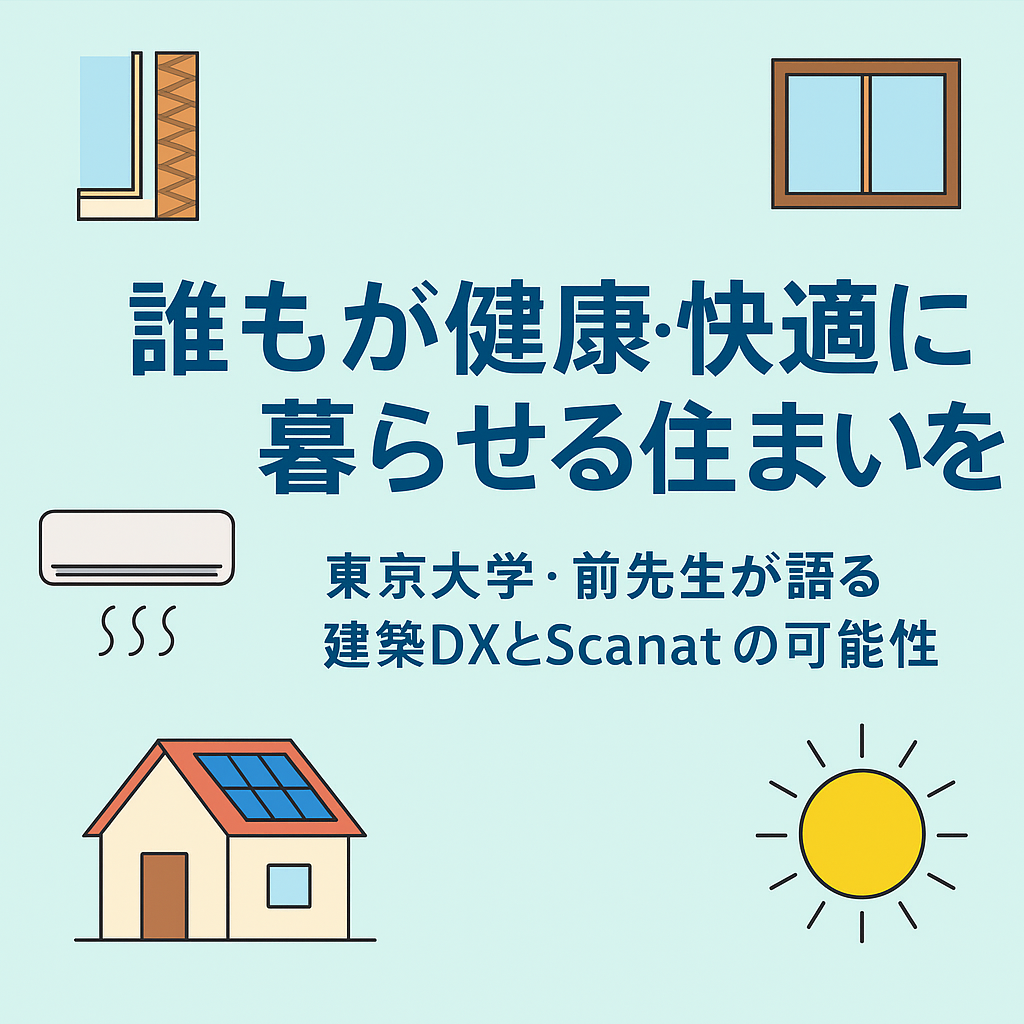
In Professor Mae’s laboratory, the following “Five Forces of Eco” are proposed as key factors supporting residential comfort and energy efficiency:
- The Power of Insulation and Airtightness
- The Power of Windows
- The Power of Equipment
- The Power of the Sun
- The Power of Control
By striking a balance among these "five elements," we can create homes where residents can live healthy, comfortable lives while making use of renewable energy.
🏚 The Existing Housing Stock and the Importance of Insulation Renovations
In recent years, the prices of new homes have been rising, and the number of new construction projects is on the decline.
On the other hand, Japan still has a large number of existing homes with inadequate thermal insulation, and improving their performance is an urgent priority. Furthermore, there is a growing need to create comfortable and safe living environments in buildings serving a variety of purposes, including rental housing, condominiums, and school facilities.
📐 Scanat × Architectural Education: Case Studies of Practical Applications
As part of a design practicum at the Edo-Tokyo Open-Air Architectural Museum in Koganei, Tokyo, a studio-style course was held that covered everything from field measurements and 3D scanning to simulation.
As part of this initiative, you utilized Scanat.
✔️ Tips for Using Scanat
- Use the LiDAR feature on the iPad Pro or iPhone Pro to 3D scan on-site buildings
- Use the web version Scanat to instantly share and view scanned data in the cloud
- Use the scan results to conduct thermal insulation planning and light and heat simulations
“For existing buildings without blueprints, the scanned data serves as a ‘substitute for memory,’” said Professor Mae.
🔁 DX is transforming architectural education and sustainable design
The reality is that many job sites lack records of past blueprints or equipment layouts.
Scanat By Scanat, you can accurately document the site conditions and create a system that allows you to “return to the site” later.
Digital transformation is steadily gaining ground in the construction industry, with a growing focus on its implementation not only in design and construction but also in the renovation phase.
💬 The essence of architecture is that it exists for people.
"Architecture exists to help people live healthy, comfortable, and happy lives. I hope that homes where people don’t have to worry about heat shock or heatstroke will become the norm."
Professor Mae describes the essence of residential design as follows:
He is working to expand the possibilities of architecture—as the foundation of happiness that encompasses not only health but also comfort and a rich quality of life —through the power of education and technology.
✅ Summary
- A former research laboratory at the University of Tokyo is currently conducting research aimed at creating "housing where everyone can live comfortably."
- Above all, our philosophy centers on the idea that architecture exists to serve people’s lives.
- Construction DX is also beginning to make a difference in the field of demolition and renovation
- Thermal retrofitting of a wide range of buildings, including existing homes, apartment buildings, and schools, is a key priority
- 3D scanning with Scanat opens up new possibilities for design education and professional practice
Technology is a means, not an end—
Scanat. As a tool for “visualizing invisible information,” Scanat helps enrich the architecture and lifestyles of the future.
🔗 Related Links