The Ministry of Land, Infrastructure, Transport and Tourism has published a collection of case studies for its “Project to Promote Efficient Construction Work Toward the Realization of Work-Style Reform,” and a case study featuring the 3D scanning app “Scanat " was featured as a result of the model project.
Background and Challenges
In light of the overtime regulations for the construction industry that took effect in April Reiwa 6, the Ministry of Land, Infrastructure, Transport and Tourism (MLIT) implemented a pilot project to promote efficient construction work as part of its efforts to achieve work-style reform. On March 24, 2025, a collection of case studies summarizing the results of this project was published, and a case study on the implementation of the 3D scanning app “Scanat ” was featured as one of the project’s achievements.
Maintenance work on national highways requires a wide range of responses—from road patrols to repairs, snow removal, and emergency operations—whether the maintenance and repair work is scheduled or unscheduled. In particular, on-site inspections prior to construction and information sharing with the project contractor are essential. However, traditional methods presented the following challenges:
- - Effort required to assess on-site conditions: Taking measurements and photographs is time-consuming, and remeasurements are often necessary.
- - Increased travel time: I have to travel back and forth between the job site and the branch office multiple times to meet with the client.
To address these challenges, Kotobuki Construction Co., Ltd.—which specializes in tunnel construction, structural repairs, and general civil engineering projects—and the provider of the 3D scanning app “Scanat ,” have collaborated to improve operational efficiency.
Initiatives and Implementation Results
- Measures
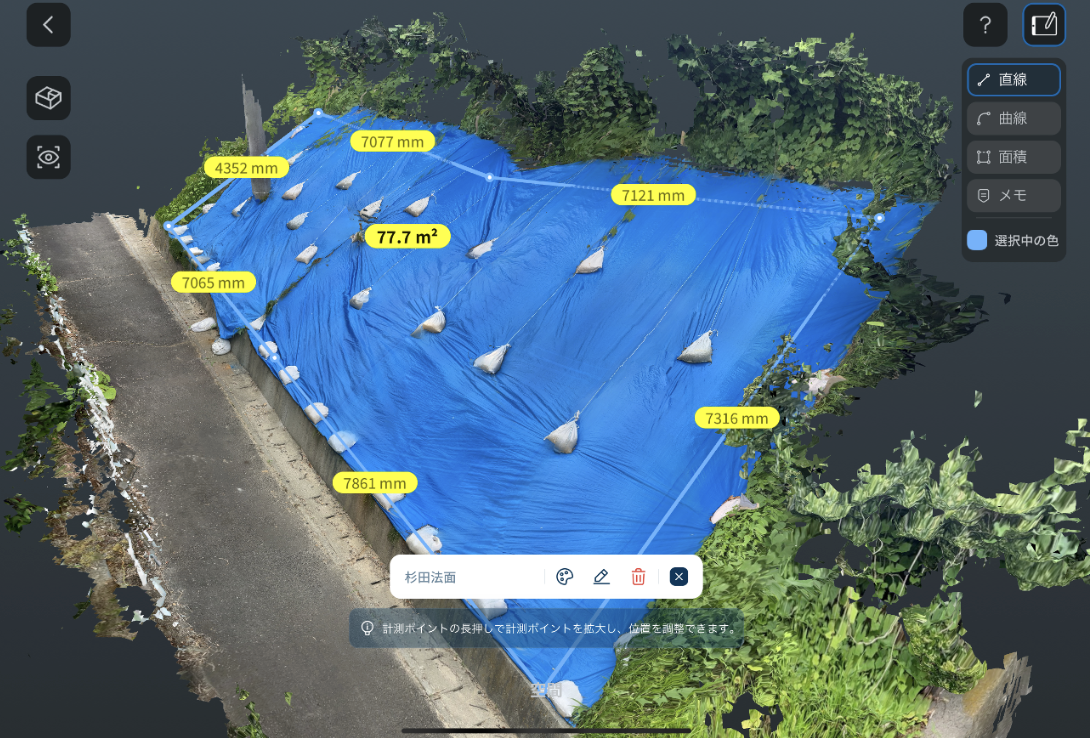
ScanatField staff carry iPads and iPhones with the app installed, allowing them to quickly create 3D models whenever they need to assess the on-site situation.
We will utilize the acquired 3D models to share information with clients online. Our goal is to achieve significant time savings compared to existing measurement processes.

- Benefits of Implementation
(1) Reduction in working hours
On-site measurement time: 36 hours/month → 15 hours/month (approximately 58% reduction)
Eliminates measurement omissions and reduces the hassle of follow-up visits.
(2) Reducing Travel Time
By conducting online meetings using 3D models, we have reduced the number of on-site inspections with the client.
There is no longer a need to visit partner companies on-site, which reduces travel time.
(3) Improving Operational Accuracy
Measurements using 3D data enable the collection of consistent data that is not dependent on the operator's experience.
We share 3D models during pre-project meetings to resolve any discrepancies in understanding among stakeholders.
*For details on the measures and their implementation results, please refer to pages 60–63 , pages 60–63.
Future Outlook
This initiative is not limited to national highway maintenance and repair work; it can also be applied to other fields, such as structural renovation projects—including tunnels—and infrastructure inspections. We will continue to strive for improved operational efficiency and quality by promoting digital transformation (DX) at construction sites.